Workplace culture has long been considered an elusive beast. Despite the best efforts of companies deploying comfort initiatives like annual satisfaction surveys or impromptu pizza parties, cultural challenges persist. Why?
These methods are largely reactive, only scratching the surface of deeper sentiment shifts that often go unnoticed until it’s too late. Now, add to this the increasing complexity of modern workplaces.
Global teams working across various time zones, office-based and remote workers co-existing in hybrid environments, and an increasing focus on diversity and inclusion – we’re dealing with a far more intricate organism than what the playbook of yesteryears is equipped to handle. It’s evident, a fresh approach is needed – one that not only comprehends the multifaceted nature of today’s workforce but also proactively anticipates and navigates cultural changes.
The Untapped Power of AI: Spotting the Invisible Pulse of Organizational Dynamics
Think of Artificial Intelligence (AI) primarily as an efficiency tool? You might want to reconsider. Its real power might lie beyond the banal tasks of automation. AI’s promise extends into a decidedly human domain – understanding the often invisible, convoluted dynamics of human interaction and sentiment at work. It’s a tool that goes beyond merely optimizing processes to enhancing empathy and engagement.
Unstructured data – the watercooler talk, emails, Slack chats, feedback results – they all generate a rich tapestry of sentiment flowing in organizations every day. Human observation might capture a hint of this, but it’s a mere scratch on the surface of the deep sentiment pool. Here’s where AI comes to the rescue. The magnitude and complexity of this data make AI indispensable. The patterns, trends, or abrupt shifts in sentiment – AI can unlock these insights buried in terabytes of data.
From an executive’s standpoint, it’s like an MRI for your company’s culture, seeing past the surface symptoms to the underlying health dynamics.
Shift your perspective. AI is not just a business booster. It’s more like a mirror, reflecting the intricate, evolving, and often hidden dynamics of your organization. This unlocks a profound understanding of your team, fostering empathy and cementing stronger bonds of engagement. AI thus holds the potential to humanize, not just mechanize, the workplace.
Shifting the Burnout Conversation: Early Warnings from AI
Does burnout sneak up on us, only revealing its ghastly face when performance dwindles? Not quite. We’ve misunderstood burnout for long enough. It’s not, as perceived, an individual problem that emerges ambiguously. On the contrary – we can see it coming. How? Enter Artificial Intelligence.
Through the analysis of anonymized communication patterns, project loads, and meeting schedules, AI brings to light early signs of team or individual stress. This SPF-50 shield from anticipatory detection prevents potential burnout before it turns into an inferno.
This approach signifies a leap from crisis control to mental well-being stewardship. No longer need we swoop in only when morale is in freefall, fire-fighting burnout while morale dips. The game changes from reactive to proactive. It’s about providing support before stress transforms into burnout, and importantly, fostering well-being as a standard, not an afterthought.
This brings us, importantly, to ethical considerations. It’s vital to not overlook data privacy for employees. Ensuring a respectful, ethical, and transparent approach in using these AI tools protects employees’ privacy rights and trust. Breaking the conventional burnout narrative and extending the olive branch of well-being support – AI steps up to the challenge, all the while safeguarding confidentiality.
AI and Psychological Safety: Unlocking Collaborative Potential
Can artificial intelligence (AI) reshape the way we relate to each other at work? Absolutely. AI insights, when implemented thoughtfully, become powerful allies in improving workplace culture. They help foster an environment of psychological safety–a non-negotiable aspect of any healthy work dynamic. Let’s delve into how AI insights improve workplace culture.
Organizational silos are detrimental to efficient communication and smooth project handling. AI aids in pinpointing these hidden communication abysses, spotlighting the need for cross-functional collaboration and thus unifying disparate teams.
AI isn’t just here to identify problems, though. Its knack for sentiment analysis in internal communication creates a means to detect covert disengagement or ‘quiet quitting.’ This early detection gives leaders a heads-up, aiding the timely intervention to rediscover lost engagement.
Let’s further examine AI’s role in the realm of inclusivity. Using AI, leaders obtain data about who is contributing in meetings and who is not. This comprehensive visibility equips them to ensure all voices find a platform, fortifying democratic team dynamics.
In addition to these, AI aids in identifying instances where employees may feel unheard or undervalued. Doesn’t an effective feedback system provide the pulse of an organization? With aggregated feedback analysis, AI sheds light on these concerns enriched with data-directed insights.
With AI crafting a secure space at work, organizations become more humane, empathetic, and productive. Offering more than just streamlined processes, AI extends the possibility of making workplaces harmonious and inclusive.
Navigating AI Implementation: A 5-Step Guide for Leaders in HR
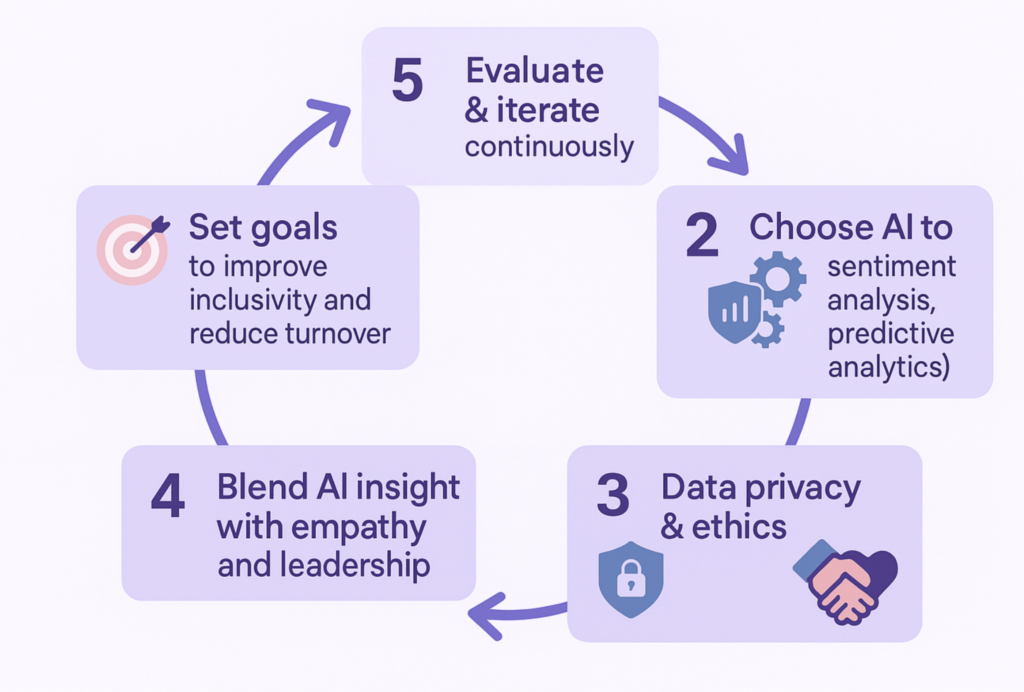
Begin by charting out defined cultural objectives. Is it about enhancing inclusivity or minimizing turnover? Once these targets are outlined, the next critical step is to choose appropriate AI tools that align with your goals.
Sentiment analysis tools can help gauge employee morale, while organizational network analysis can spotlight communication gaps. Meanwhile, predictive analytics can be instrumental in assessing the possibility of traumatic turn of events like burnout, or attrition.
As you select these AI tools, striking a balance between helpful insights and employee privacy becomes crucial. Map out ethical guidelines that ensure data privacy, but still offer the valuable insight AI provides.
Next, avoid slipping into the tempting trap of letting AI make all the decisions. Guestimates and gut feelings still confer value over machine learning when it comes to people relations. Human leadership, interspersed with sprinkles of AI insights, can foster unity and understanding.
Lastly, engrave an iteration mindset. As the organization evolves, so might your objectives. It’s necessary to reevaluate both AI tool efficiency and cultural objective relevancy continually.
Undeniably, the magic spell for a future-proof workplace lies in the artful blend of artificial and emotional intelligence. AI insights hold the potential to be an ally, not a replacement. They can augment human decision-making, accentuating an HR leader’s potential to cultivate a positive and vibrant workplace culture.
Balancing AI Advantages and Risks in Cultural Enhancement
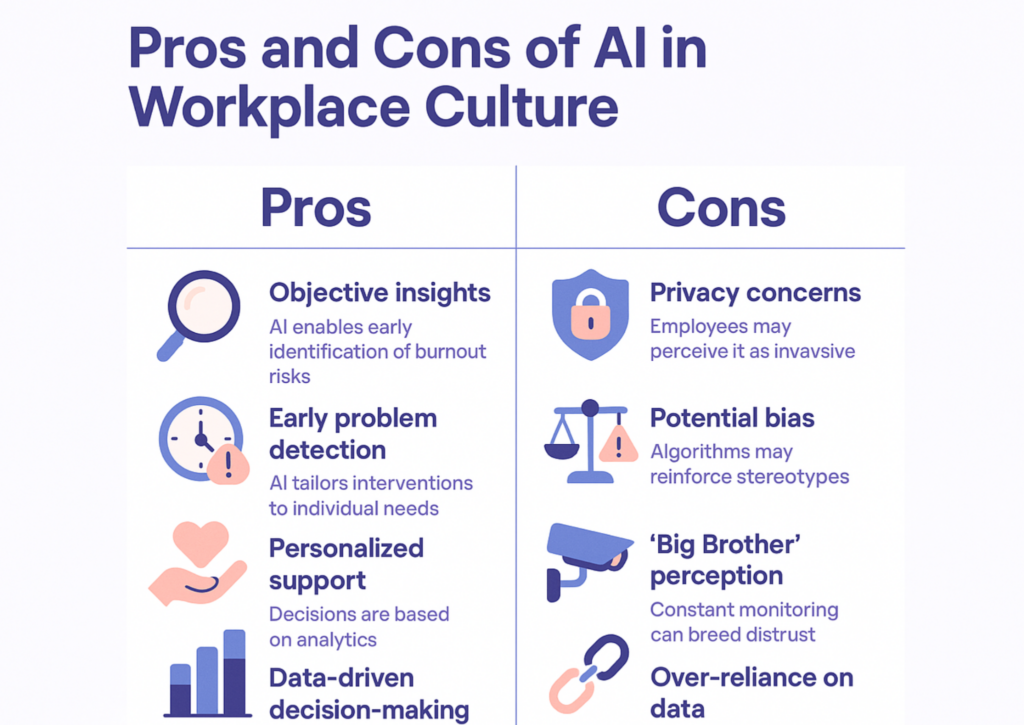
Implementation of AI in shaping workplace culture presents both potential boons and potential pitfalls. Understanding these is crucial to ensure respectful and responsible use of the technology.
| Pros | Cons |
| Objective insights – AI algorithms, in their detachment, see facts, not facades. They rely on raw data, offering unbiased analysis | Privacy concerns – Mining data can cross the line into invasion of personal space. Leaders need to strike a balance between helpful insights and individual privacy |
| Early problem detection – AI catches signs of trouble well before they emerge as full-fledged issues, enabling preemptive action | Potential for bias in algorithms – Inherent biases in AI systems present a risk. Machine learning can unintentionally replicate discriminatory behaviours or attitudes prevalent in initial training data |
| Personalized support – AI can customize suggestions to individual employee needs, facilitating personal development | ‘Big brother’ perception – Increased monitoring can spark fears of over-surveillance making employees uncomfortable |
| Data-driven decision-making – AI provides powerful analytical capabilities, supplementing intuition-based decisions | Over-reliance on data without human context – Don’t treat AI insights as gospel. Cherishing the human element in decision-making retains the warmth in workplace relationships |
While the advantages of AI in culture building are significant, the ethical concerns demand equal attention. Fostering transparency in data usage, continuously reviewing AI system biases, and maintaining an ethical approach to employee monitoring can help mitigate these risks. Remember, technology becomes a tool of empowerment when used with empathy and understanding. AI, when used judiciously and ethically, can truly revolutionize any workplace.
A Unicorn’s Leap: Tech Transformed by Trialing AI Ethics
Imagine a thriving tech company, let’s call it ‘Unicorn Inc.’ Boasting of a culture rooted in transparency, it first visibly stuttered when employee engagement surveys hinted at a stark discord between proclaimed values and workforce perception. Spotting a worrying undercurrent, the leaders decided to employ AI analysis on their internal communication platforms – all while scrupulously preserving anonymity.
Unexpectedly, the data illuminated a concerning trend of information hoarding and choked decision-making. An echo chamber had formed, contradicting the transparency they proudly promoted. Decisive action was required. Hence, leadership training was rolled out to evolve effective communication strategies and facilitate information flow. This, in conjunction with new streamlined communication protocols, became their winning formula.
Workplace atmosphere gradually warmed up again, with improvements in employee trust and engagement expressing the change. The culture was readjusted, and transparency was more than a buzzword – it was lived and felt among every member of Unicorn Inc. The mini-case of Unicorn Inc. becomes a beacon for how to turn around company culture using ethical AI.
Rethinking Leadership: Embracing AI’s Human-Centric Future
Remember, AI isn’t meant to replace the uniqueness of human intuition and decision-making, but rather enhance it. The technology stands as an invaluable aid in diagnosing workplace culture’s health, sparking the potential for proactive, compassionate interventions.
Yet, let’s be clear – these systems must not operate unchecked. Ethical implementation and human oversight are essential, undeniable facets of this process. The objective in sight is a seismic shift toward a more inclusive, engaged, and psychologically safe workplace that values its people as much as productivity, if not more. The ball is now in your court, leaders. Are you prepared to champion this human-augmented future?
A Reimagined Culture Fit: Future-Proofing with AI
Let’s get one thing straight: AI is not usurping human connections but playing a remarkable role in magnifying them. It’s cultivating a more profound understanding, a nuanced perception of workplace dynamics. Now, it’s time for us all to shift our definition of ‘culture fit.’ It shouldn’t imply homogenizing the workforce under a singular value system.
On the contrary, imagine it as a vibrant, continuously adapting ecosystem, amalgamating both AI insights and human empathy. See it as a balancing act between conformity and innovation, stagnation and evolution, always teetering but never falling. Embrace this perspective, and the workplaces of tomorrow hold boundless potential for genuine thriving. Will you spearhead this revolution?