Will the brushstrokes of an AI outshine the creative genius of a human artist? As many debate this question, an unexpected revolution in creativity is emerging from the digital realm. Artificial intelligence is not just transforming our design tools; it’s redefining our entire cultural fabric, rules of design, and even the role of an inspiration or muse.
This article aims to demystify the multifaceted ways AI impacts art and design, navigating beyond sensationalist headlines to the actual shifts taking place. Let’s delve into the world of generative art, AI ethics in creativity, and the evolving role of artists in the age of AI. Because it is not just about the technology; it’s about a paradigm shift that charts a new course for human-AI collaboration.
AI Evolution in the Art Sphere
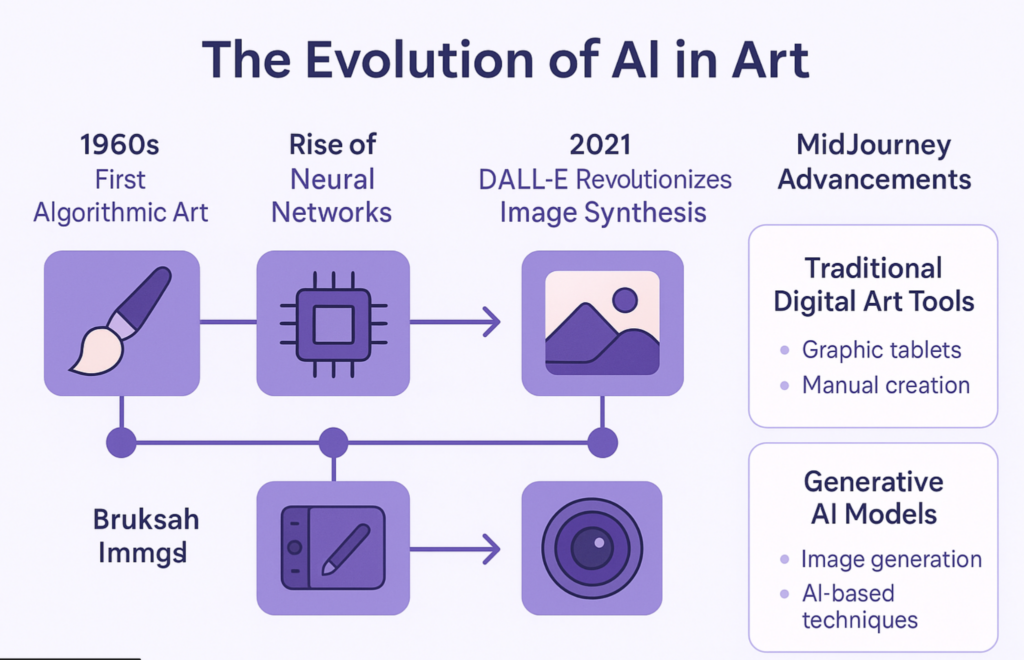
Starting with humble beginnings in algorithmic art, Artificial Intelligence has managed to etch a prominent place for itself in the creative realms of art and design. Remember, initial explorations revolved around simple patterns and automatic drawings, far from the richly detailed and imaginative outputs we see today.
Fast forward to the present, AI-powered tools like Midjourney and DALL-E are ushering in an unprecedented creative paradigm. Unlike traditional digital art software, primarily designed to manipulate existing images, these AI tools trace a different path. They’re not just tools but creative partners, endowed with the ability to understand and generate something entirely new from a simple prompt.
This advancement marks a significant shift in how we perceive art, blurring the lines between artist and tool. Perhaps, in this AI-enabled future, the artist isn’t just a wielder of tools but becomes a curator of machine-infused creativity.
Tug of War: Human-AI Collaboration and AI Autonomy in Creativity
Let’s be clear: AI is not merely a tool anymore. It has grown into a creative partner, capable of generating novel ideas and styles. Human-AI collaboration opens up a new universe of creative possibilities and can speed up the ideation process. It’s a breath of fresh air in the art sphere, democratizing art creation. But, it’s not all rosy. There’s a potential for de-skilling too. And then there’s the elephant in the room – the ethical dilemma of authorship.
AI’s autonomous creative capabilities, on the other hand, are pushing boundaries in art and design, venturing into unexplored territories. Yet, its creations lack the genuine ‘intent’, an inherent trait of human creativity. Adding to this is the contentious issue of copyright and the perceived soullessness of AI-generated art.
Both these dynamics paint a complex picture of the future of creativity, as AI continues to redefine the role of the artist and the canvas. Let’s further dissect these undercurrents:
| Human-AI Collaboration | AI Autonomy | |
| Pros | Expands creative possibilities, speeds up ideation, democratizes art | Generates novel styles, pushes boundaries |
| Cons | Risks of de-skilling, ethical quandaries of authorship | Lack of ‘intent’, copyright issues, perceived absence of ‘soul’ |
Delving into these perspectives offers critical insights for artists, designers, and tech enthusiasts alike. It nurtures an understanding of the changing dynamics of creativity in the AI era. It’s time for a careful dance between human creativity and AI’s growing power. This synergy will shape the future of the art world and the broader cultural fabric. Let it be an informed, intuitive, and inspired dance.
Designer Downfall: A Misconception Shattered
AI replacing artists and designers is a colossal anxiety looming large over the creative landscape. Nevertheless, it’s time to reaffirm this – that belief is misguided.
What AI does is reorder the role of the creators, not discard them. It’s not about the elimination of human intelligence but the reframing of its application. The advent of AI nudges the focus to shift from mere execution to curation and concept formation for human creators. AI’s encroachment on the creative world, in this way, is more of an evolution than an extinction event.
Here’s the reality: despite AI’s impressive capabilities, it lacks the intuition, emotive cognition, and cultural articulation that’s intrinsically human. AI might weave intricate designs based on algorithms, but it can’t discern why a certain style elicits joy or why abstract art might seem rebellious.
In a nutshell, an artist’s role in this AI age morphs, with prompt engineering and conceptualizing gaining precedence. So yes, AI may be redefining roles in art but it’s far from sounding the death knell for human creativity.
The Cultural Ripples of AI: More than Just Art
AI, far from remaining confined to high art, is leaving tangible imprints on culture. Its implications spread as far as:
- The creation of personalized content. Instead of the one-size-fits-all approach characteristic of mass media, AI can now generate music and stories tailored to individual tastes. No longer are we just passive consumers, but also part of the creative process.
- The upheaval of visual aesthetics and trends. AI can generate myriad visual possibilities beyond human imagination, pushing us to rethink art norms and traditional aesthetics.
- The representation and bias in AI-generated content. With AI, comes the mirror reflection of our cultural biases and stereotypes. It’s a stark reminder of the ethical considerations we need to address in this brave new digital world.
- Spreading the joy of creation. AI democratizes art, making it accessible to many who might not ordinarily engage with it. Now, more people can create and explore art without financial barriers or lack of technical skills.
- The blurring lines between reality and simulation in media. AI-generated deepfakes and virtual realities are shifting our perception of what constitutes reality. It’s an intriguing landscape of virtual illusions that challenge our ingrained norms.
Influencing culture is no small feat, and AI, through its innovative capabilities, is doing just that – stirring the existing pot of cultural norms, aesthetics, and ethical concerns while offering new avenues of creativity. Its cultural footprint is far-reaching, steadily reshaping our shared human experience. It’s not just our art that’s evolving; it’s our collective consciousness.
AI Education: Forging Future Innovators
When we talk about AI in education, it’s not just about prepping today’s students for a digital future; it’s much more about nurturing the innovators who will shape that future. Riding the wave of AI, we can now evangelize a fresh pedagogical approach, one that encourages students to tinker with a symphony of ideas, trial-and-error their way through complex problems, and ultimately, contribute to a creative landscape that’s ever in flux.
Consider AI-based platforms like Edubrain, which serve as rostrums for experiential learning. Interactive modules keep children engaged, stimulating their creativity with AI games for kids. Early exposure to such technologies not only hones their understanding of AI but also fosters lateral thinking and problem-solving skills.
As students mature, they can leverage tools like the best AI homework solver for complex research or a math photo solver to decode the geometry behind classical art compositions, quite the practical tool for artists attempting to see geometry in a new light.
Education, with AI at its heart, is no longer restricted to textbook knowledge.
It’s a rollercoaster ride through the corridors of creative curiosity, churning out young minds eager to experiment, innovate and break the mould. In this brave new world, AI is not teaching students what to learn but rather showing them how to learn. nurtifying not just learners but creators, pioneers of the future.
Ethics Amid AI Artistry: Bias, Copyright, and Authenticity
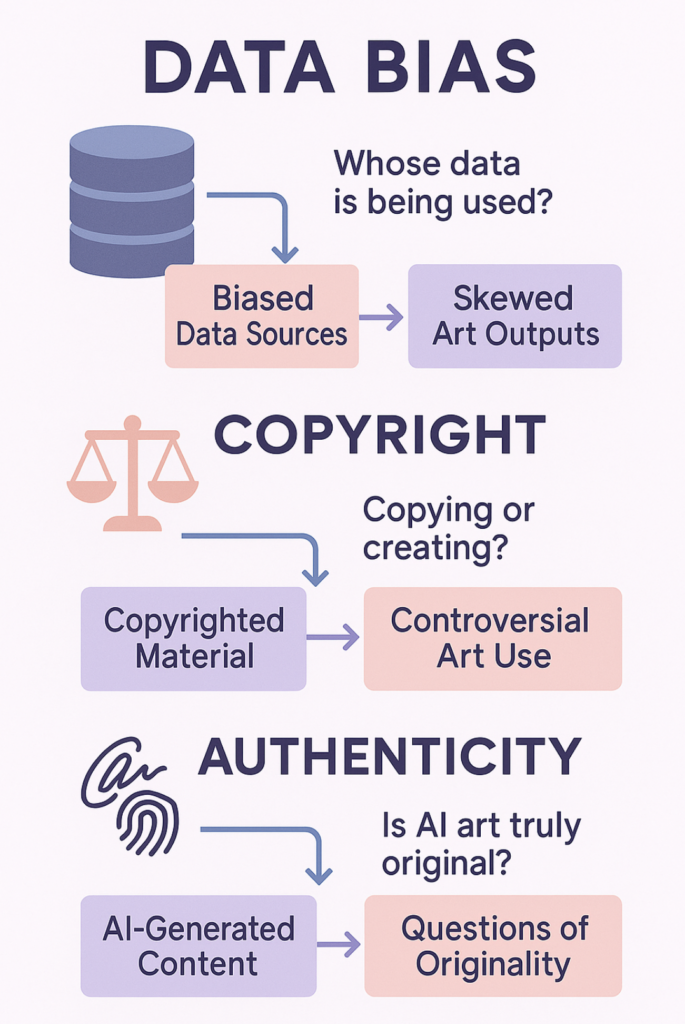
Allow me to introduce a fresh complication: ethics. Data bias in training sets gives birth to biased outputs, undermining the art’s integrity. Imagine an AI-fed diet of romantic paintings that omits artists of color—we end up training a bot with a myopic lens on romance. Intriguing, don’t you think?
With AI models trained on current art, the copyright conundrum rears its head. Are the rights of original artists infringed upon? Who owns AI art—the coder, the AI, or the artist who inspired the training set?
Moreover, let’s dwell on ‘authenticity’. If an AI produces the artwork, is it genuine art? What does ‘original’ mean in the context of AI-generated masterpieces? These questions keep us guessing, but one fact remains clear—AI is reshaping the canvas of art and ethics jointly, prodding the art world, and indeed society, to grapple anew.
Towards a Harmonious Fusion: Human-AI Collaboration in Art
Art is standing before a new horizon, with AI as an undeniable force reshaping its contours. We are witnessing the metamorphosis of creativity—human imagination is still essential, but its form is evolving and blending with machine learning in unexpectedly harmonic ways.
With the advent of AI, ethical quandaries have emerged that stir up debates about bias, copyright, and authenticity. These considerations demand our attention, urging us to guide AI’s development with a conscious, balanced hand.
The new landscape is thrilling yet it could be an upheaval for those unprepared. Regardless, education and adaptability remain our sturdy oars amidst these swift currents, helping us navigate these uncharted waters seamlessly.
Lastly, the pièce de résistance is the human-AI synergy in the offing—this unique blend is likely to produce the most exciting art, unifying human creativity with the innovative prowess of AI. Exciting times lie ahead, indeed. Look out world, here comes the future of art!
Fanning out the Future: Art and AI
Art shaped by AI—we stand on the brink of a fresh epoch, marked by deep and intricate hues of complexity. Be forewarned, the canvas ahead is not mono-tone but rather a kaleidoscope that flickers with promise and pitfalls.
Relishing in the wonder of AI’s creative output? Indeed, we should. Yet, we must also bear the weight of responsibility that comes with it. The cultural tapestry we weave shall be adorned by the decisions we make today about AI’s cultivation, oversight, and integration.
Far from a fait accompli, AI’s imprint on art and culture remains an unfolding saga. A story not dictated solely by relentless codes or intricate algorithms, but sculpted by our collective human will. Amid the chaos of swirling pixels and data-breathing models, remember this—AI in art is a tool in our hands, a brush awaiting our command. How we wield it will define the ensuing era.
So, gazing upon the horizon, we are not mere spectators to a digital downpour but architects of a new dawn. In this, lies our marvel, and in this, too, rests our mandate. The future of art with AI is ours to shape.